
I’ve trained a lot of forklift operators over the years, and there’s one request I get more than any other: “I just need the OSHA-approved online certification.”
I always have to pause there, because the honest answer is that no such thing exists. OSHA doesn’t approve online forklift certifications. It doesn’t approve in-person ones either. That’s not a knock on online training, which I recommend often. It’s just that OSHA doesn’t put its stamp on any training provider.
This catches a lot of people off guard. So let me lay out what OSHA actually requires, what you really can finish online, and what still has to happen in person before anyone gets on a forklift.
Whether you’re an operator trying to get hired or an employer trying to certify your crew, you’ll know where you stand by the end.
Is There an OSHA-Approved Online Forklift Certification?
The Short Answer
No, and this point matters enough to be blunt about it.
OSHA does not approve certification programs. There’s no official list of approved providers, no government seal, no course that OSHA runs or signs off on. OSHA also doesn’t issue forklift licenses. There’s no card with an OSHA logo that says you’re cleared to drive.
What OSHA does is set the rules employers have to follow. You can read them yourself at 29 CFR 1910.178. Those rules cover what training has to include and how operators have to be evaluated. But making sure it happens is the employer’s job, not the training provider’s and not OSHA’s.
So when a website says “OSHA approved,” the most it can honestly mean is “OSHA compliant.” That difference matters, and I’ll get to it.
Why People Search for “OSHA Approved”
I don’t blame anyone for searching those words. It’s the language the industry taught everyone to use. Plenty of training companies put “OSHA Approved” right in their headlines because they know that’s what people type into Google. It’s marketing.
The accurate term is “OSHA compliant,” meaning the course content matches what the regulations require. That’s worth something. A compliant course covers the right topics, tests you, and gives you documentation. But compliant and approved are not the same thing.
A company that tells you it’s “approved by OSHA” is either careless or counting on you not to ask. Now you’ll ask.
What OSHA Actually Requires for Forklift Operator Training
OSHA splits operator training into three parts, and you need all three.
Formal Instruction
This is the classroom side, the part where you learn the theory. How forklifts work, why they tip, load limits, pedestrian safety, refueling and charging. OSHA doesn’t dictate how you take in this material. It can be online training, a classroom session, video, written materials, or a mix. This is the part online courses handle well.
Practical Training
This is the hands-on side. The trainer demonstrates, then you operate the truck yourself. You get used to the specific equipment, practice the controls, move the truck, and handle loads. You can’t learn the physical operation of a forklift from a screen, full stop.
Operator Evaluation
Finally, the employer, or someone they put in charge who knows what to look for, has to watch the operator work and judge whether they can run the truck safely in the place they’ll actually be working. This isn’t a box to check. It’s someone qualified watching you operate and confirming you’re ready.
You need all three. There are no exceptions.
Can You Get Forklift Certified Completely Online?
You can finish a big chunk online, but not all of it.
What You Can Complete Online
The formal instruction part is fair game for online learning, and it covers a lot:
- Safety training, the habits that keep you and the people around you safe
- OSHA theory, the regulations, your responsibilities, and the reasoning behind the rules
- Hazard recognition, spotting pedestrians, unstable loads, dock edges, blind corners, and everything else that causes accidents
- A written exam to confirm the material actually stuck
You can do all of that at your own pace and come away with a certificate showing you finished the formal instruction. That’s useful.
What Must Be Done In Person
Here’s what a screen can’t do:
- Practical training, where you operate the truck under supervision
- A driving evaluation, where someone watches and assesses you on the controls
- The employer’s sign-off, the authorization that clears you to operate their equipment in their building
If someone tells you that you can be fully certified online, with no in-person steps at all, they’re not being straight with you. The online course is the first half. The hands-on evaluation is the second half.
What Makes an Online Forklift Course OSHA Compliant?
Since “approved” isn’t real, “compliant” is the bar you want. A good online course should:
| Feature | Why It Matters | What to Look For |
|---|---|---|
| ✅ OSHA-Compliant Curriculum | Covers the topics required under OSHA’s Powered Industrial Truck standard, ensuring operators receive the necessary safety knowledge. | Includes forklift fundamentals, load handling, inspections, hazard recognition, stability, and safe operating practices. |
| 📚 Comprehensive Training Modules | Provides structured instruction that prepares students before hands-on training begins. | Interactive lessons, videos, quizzes, and easy-to-follow content. |
| 📝 Final Knowledge Exam | Confirms the learner understands the material before completing the course. | A graded exam with review opportunities and retakes if necessary. |
| 🎓 Certificate of Completion | Documents that you’ve successfully completed the formal instruction portion of forklift training. | Printable certificate available immediately after passing the exam. |
| 👷 Employer Evaluation Support | OSHA requires a practical evaluation before an operator can be authorized to use a forklift. | Evaluation forms or documentation employers can use during hands-on assessments. |
| 🔄 Up-to-Date OSHA Content | Regulations and industry best practices evolve over time. | Course content that is regularly reviewed and updated to reflect current OSHA requirements. |
| 📱 Mobile-Friendly Learning | Allows students to complete training anytime, anywhere, using their preferred device. | Works smoothly on smartphones, tablets, laptops, and desktop computers. |
| 💳 Wallet Card Included | Makes it easy to carry proof of completed formal training while on the job. | Printable or mailed wallet-sized certification card. |
| 🌎 Multiple Language Options | Helps improve comprehension for a diverse workforce. | English, Spanish, and other language options when available. |
| 🤝 Responsive Customer Support | Provides assistance if you encounter technical issues or have questions about your training. | Phone, email, or live chat support with knowledgeable representatives. |
A course that hits all of those is treating you fairly.
How the OSHA Forklift Certification Process Works
Here’s the whole thing from start to finish:
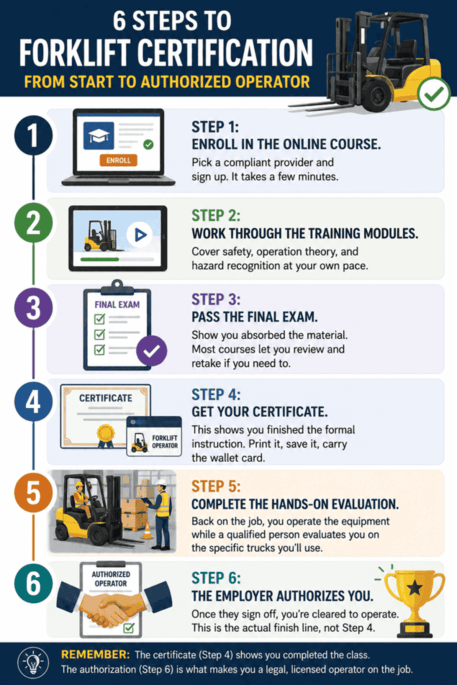
I point that out because plenty of people think the certificate is the end. It isn’t. It’s what gets you to Step 5.
Who Can Take Online Forklift Certification?
Pretty much anyone who’s going to be working around lift trucks. Over the years I’ve trained:
- New operators who’ve never touched a forklift
- Experienced operators refreshing their training or starting with a new employer
- Warehouse workers moving pallets all day
- Manufacturing workers feeding the line
- Construction workers running rough terrain lifts
- Retail workers in big stockrooms
- Temporary workers who need to get up to speed fast
If your job puts you near these machines, the training is for you.
Benefits of Online Forklift Certification
I do this work in person, but I’ll happily make the case for the online instruction part, because the upsides are real:
- Flexible timing. Train at midnight, on a lunch break, whenever works.
- Train from anywhere. Kitchen table, break room, parking lot.
- Lower cost. Usually cheaper than an in-person class.
- Faster. No waiting for the next scheduled session.
- Immediate certificate. Finish and print it on the spot.
- Clean documentation. Records that make compliance simple for employers.
For the classroom portion, it’s hard to beat. Just remember it’s the start, not the finish.
What Types of Forklifts Are Covered?
OSHA recognizes several classes of powered industrial trucks, and good training touches the common ones:
| Forklift Type | Primary Use | Where You’ll Commonly See It | Special Training Considerations |
|---|---|---|---|
| 🟨 Counterbalance Forklifts | The most common forklift for lifting and transporting palletized loads. Available in electric, propane, diesel, and gasoline models. | Warehouses, manufacturing plants, lumber yards, shipping docks | Operators must understand load capacity, stability, turning radius, and safe load handling. |
| ⚡ Electric Forklifts | Designed for indoor use with zero exhaust emissions and quieter operation. | Warehouses, food distribution centers, retail distribution centers | Includes battery charging procedures, battery maintenance, and electrical safety. |
| 📦 Reach Trucks | Built to retrieve and store pallets in narrow aisles and high storage racks. | High-density warehouses and fulfillment centers | Requires training on extended reach, mast stability, visibility, and operating at elevated heights. |
| 🏗️ Order Pickers | Raises the operator along with the platform to manually pick individual items from racks. | E-commerce fulfillment centers and large distribution warehouses | Fall protection, elevated work practices, and safe maneuvering are critical training topics. |
| 🚚 Powered Pallet Jacks (Walkies/Riders) | Used to move palletized loads over short distances without lifting them to significant heights. | Grocery warehouses, retail stores, beverage distributors | Operators learn pedestrian awareness, stopping distances, and proper load control in congested areas. |
| 🌄 Rough Terrain Forklifts | Heavy-duty forklifts with large tires designed for uneven outdoor surfaces. | Construction sites, lumber yards, agriculture, oil & gas | Special emphasis on slopes, unstable ground, outdoor hazards, and larger load capacities. |
| 🪑 Sit-Down Forklifts | Traditional forklift where the operator remains seated during operation. Can be electric or internal combustion. | Most warehouses, manufacturing facilities, freight terminals | Training includes proper seating position, seat belt use, safe travel, and visibility techniques. |
| 🚶 Stand-Up Forklifts | Operator stands while driving, making them ideal for frequent mounting and dismounting in tight spaces. | Narrow aisle warehouses and high-volume distribution centers | Requires instruction on operator compartment safety, emergency exits, and precise maneuvering. |
Here’s something operators miss: training doesn’t carry across every machine. The classroom theory does, but you have to be trained and evaluated on the specific type of truck you’ll run. Being signed off on a sit-down counterbalance doesn’t clear you for a reach truck. Different machine, different evaluation.
How Long Does Online Forklift Certification Take?
Faster than most people expect. A few things affect the timing:
- The provider, since some courses are leaner than others
- Your own pace, which you control
- Your experience, since people who’ve done this before move quicker
For the online instruction, the usual range is one to three hours, and a lot of people finish the same day they start. The hands-on evaluation is separate and depends on your employer’s schedule, but the classroom part is quick.
How Long Is Forklift Certification Valid?
This is another area full of bad information, so here’s the accurate version.
OSHA requires each operator to be evaluated at least once every three years. That’s the headline. But three years is a maximum, not a guarantee. Several things require refresher training and a new evaluation sooner:
- After an accident or near-miss
- After someone observes unsafe operation
- When the operator moves to a different type of equipment
- When workplace conditions change in a way that affects safe operation
So it isn’t a clean three-year cycle you can forget about. If something raises a real question about an operator’s safety, retraining happens then, not at the next scheduled date.
How Much Does Online Forklift Certification Cost?
It varies, but the online instruction is one of the cheaper parts of getting certified. A few things drive the price:
- The provider and what’s included, like wallet cards, support, and employer resources
- Whether the employer is paying, which many do, since training their crew is on them anyway
- Group rates, which most providers offer when you’re certifying a whole team
For an individual, the online course is usually a modest cost. For employers certifying a crew, group pricing brings it down further. And since the law puts the training obligation on the employer, operators should always ask whether the company will cover it.
Does an Online Forklift Certificate Help You Get a Job?
Yes, with one honest caveat. An online certificate won’t be everything an employer needs. They still have to do their own evaluation on site before you operate. But it does help you:
- It shows initiative, since you took the time to learn the safety material on your own
- It covers the formal instruction requirement, so one full part is already done
- It lets the employer focus on the hands-on part, which gets you working sooner
- It makes you more employable, because you show up already understanding the rules and hazards
A candidate who arrives with the classroom part finished and a wallet card in hand is easier to hire than one starting from zero. It says you take the work seriously.
Common Myths About OSHA Online Forklift Certification
Let me clear up the ones I hear most.
Myth #1: OSHA approves online courses. It doesn’t approve any course, online or otherwise. OSHA sets the standards and providers try to meet them.
Myth #2: An online certificate lets you drive any forklift. It doesn’t. You still need a hands-on evaluation on the specific equipment you’ll operate.
Myth #3: Forklift licenses never expire. There’s no permanent license. Operators have to be re-evaluated at least every three years, sometimes sooner.
Myth #4: One certification works everywhere. It doesn’t. Site conditions matter. A new employer or a very different work environment means a new evaluation.
Myth #5: Hands-on training isn’t necessary. It’s required. No good trainer would skip it, and no compliant program would let you.
Final Thoughts
If you remember one thing, make it this: OSHA does not approve online forklift certification providers. That phrase is marketing, not regulation.
The truth is more useful anyway. Online training can fully cover the formal instruction part of OSHA’s requirements, and it’s a flexible, affordable, fast way to do it. But hands-on training and a real employer evaluation are still required before anyone operates a forklift on the job. That isn’t bureaucracy. It’s what keeps operators and the people working near them safe.
If you’re an operator, finish the online course and show up with your certificate. You’ve already proven you take safety seriously. If you’re an employer, a good compliant course handles the classroom part cleanly and keeps your documentation simple, so you can put your time into the hands-on evaluation that’s legally yours to do.
Pick a solid course, take all three parts seriously, and you’ll be set up to operate safely. That’s what matters.
