
Wrapping up an online forklift course feels like a win, and honestly, it is. You’ve sat through the lessons, picked up the safety rules, and passed the test at the end.
But here’s the thing most people don’t expect: that “course complete” message on your screen isn’t the actual finish line. It kicks off a short list of steps that turn your training into real permission to run a forklift at work.
Knowing what’s coming saves you a headache, keeps you square with OSHA, and gets you on the equipment sooner.
So let’s walk through what really happens once your online training is behind you, starting with your documents and ending with the workplace check that ties it all together.
You Pass the Final Exam and Unlock Your Documents
First up is the knowledge test. Most online forklift programs close out with a multiple-choice exam covering the stuff you just learned: how loads stay stable, how to handle them, how to inspect the machine, watching out for people on foot, and the OSHA rules behind all of it. You’ll usually need somewhere around 70 to 80 percent to pass.
Pass it, and your training documents open up right away. That’s one of the best parts of going the online route instead of sitting in a classroom. No mail. No waiting around for days or weeks. The paperwork gets generated on the spot, ready to download in a matter of minutes.
Didn’t pass on your first shot? Take a breath. Good providers let you retake the test, usually for free, so you can brush up on the material and go again until you’ve got it down.
Download and Print Your Certificate and Wallet Card
Once you pass, you’ll typically get three documents:
A certificate of completion, which shows you finished the formal instruction part of your training. Hand this one to your employer and keep a copy for yourself.
A wallet card, a small, carry-it-anywhere proof of training. Supervisors and safety folks sometimes ask to see it, so it’s handy to have in your pocket.
An employer evaluation form, sometimes called a practical evaluation checklist. This one might be the most important of the bunch, and I’ll get into why in a second.
Save digital copies to your phone and somewhere in the cloud, then print at least one of each. A lot of operators stash the certificate at home and keep the wallet card on them at work.
Training and Certification Aren’t the Same Thing
Here’s the big one, and it trips up plenty of people: finishing the online course doesn’t fully certify you to run a forklift on its own.
Let me explain what the rules actually say. OSHA regulation 29 CFR 1910.178(l) spells out three parts every forklift operator’s training has to include:
- Formal instruction, meaning lectures, written material, videos, and online learning.
- Practical training, which is hands-on time operating a real forklift.
- An evaluation, where someone watches you work and assesses how you do.
Your online course handles that first part, and it does it well. What it can’t do through a screen is the hands-on practice and the in-person evaluation. Those have to happen in the real world, on an actual machine, with a qualified person watching.
Think of it this way. When you finish the course, you’ve nailed down the knowledge. The remaining steps connect that knowledge to skill someone can actually see you demonstrate.
Complete the Hands-On Evaluation at Your Workplace
Next comes the practical evaluation, and this is where that employer evaluation form earns its keep.
OSHA wants a qualified person, usually your employer, a supervisor, or a designated trainer, to watch you run the exact type of forklift you’ll be using and confirm you can do it safely. That check usually includes things like:
- Doing a pre-operation inspection
- Getting on and off the machine the right way
- Starting, steering, and stopping without drama
- Picking up, carrying, and setting down loads
- Working in tight spots and around people
- Handling ramps or inclines if your job calls for it
- Parking and shutting down properly
This has to take place in the actual spot where you’ll be working. The aisle widths, the floor surface, the foot traffic, the kinds of loads you’ll move, all of it shapes whether you can operate safely, so the evaluation has to reflect real conditions.
After your online course, you bring that evaluation form to work. The qualified person watches you, checks off each skill, and signs the form. That signature is what finishes the certification process and clears you to operate.
Hand Your Documentation to Your Employer
Once the form is signed, your employer keeps your full certification record on file. OSHA requires them to hold onto documentation that includes your name, the training date, the evaluation date, and who did the training and evaluation.
This isn’t just box-checking for the sake of it. If OSHA ever shows up after an incident, that paperwork proves the employer trained and evaluated its operators the right way. Missing or sloppy records, by the way, are one of the most common forklift citations OSHA hands out.
So once you’re done, give your employer copies of your certificate and signed evaluation form. Keep your own copies too. If you move to a new job down the road, your next employer might count your formal training as a head start, but they’ll still need to run their own evaluation on their equipment and in their building.
You’re Certified for Specific Truck Types, Not All of Them
People often assume one certification covers every forklift out there. It doesn’t. Your training and evaluation apply only to the classes and types of trucks you actually trained and got evaluated on.
OSHA breaks powered industrial trucks into seven classes, everything from electric sit-down counterbalanced forklifts to rough-terrain machines and order pickers. A sit-down warehouse forklift drives nothing like a stand-up reach truck or a telehandler. If your job later puts you on a different type, you’ll need more training and a fresh evaluation for that machine.
Once you finish your course, take a minute to check which truck types you’re certified on and line that up against what your job really requires.
Mark Your Calendar for Recertification
Forklift certification doesn’t last forever. OSHA requires operators to be re-evaluated at least once every three years. When you wrap up your training, jot down the date so you know when that three-year window closes.
A few situations also call for retraining before those three years are up, no matter where you are in the cycle. You’ll need to be retrained and re-evaluated if:
- You’re in an accident or a close call
- Someone catches you operating unsafely
- You get assigned a different type of truck
- Something changes in your workplace that affects safe operation
Staying on top of these protects you, the people around you, and your employer.
Get Behind the Controls With Confidence
With your online training done, your evaluation signed, and your employer holding the paperwork, you’re cleared to operate. This is where everything you learned starts to pay off. That stability triangle isn’t just a diagram anymore. It’s the reason you keep your load low and tilted back. The inspection checklist stops being a chore and becomes how you catch a hydraulic leak before it turns into a dropped load.
The best operators don’t treat the end of training as the end of learning. They treat it as the start of good habits. A forklift is one of the handiest machines on any worksite and one of the most dangerous when someone gets careless. The whole certification process exists to keep you on the right side of that line.
Quick Recap: From “Course Complete” to “Cleared to Operate”
Here’s the short version of what happens after you finish online forklift training:
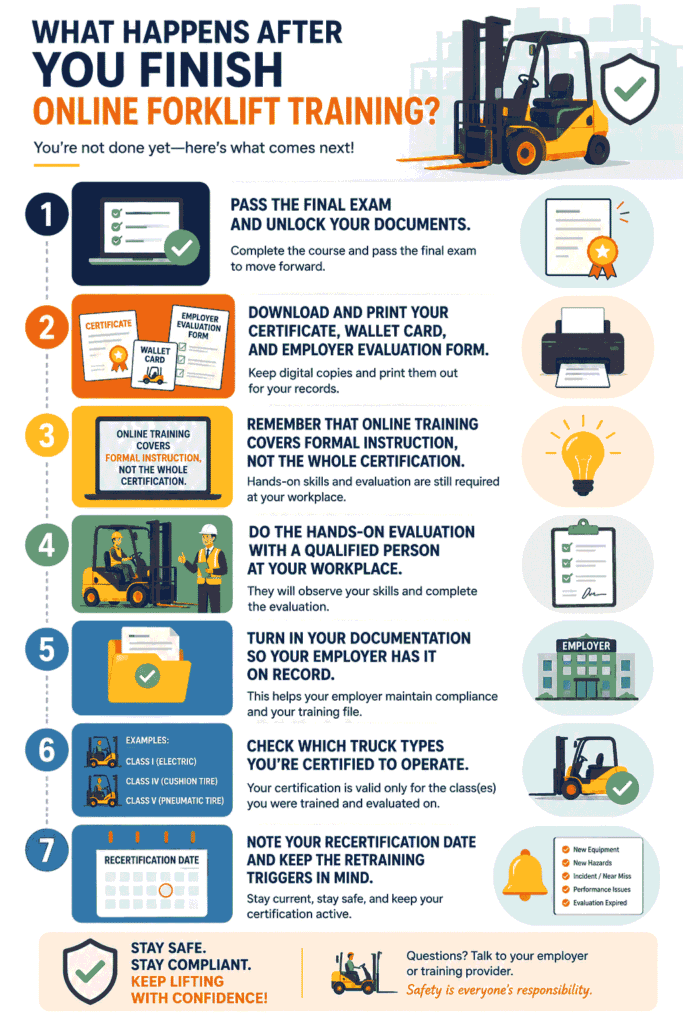
Finishing the online portion is a real accomplishment, and it’s the quickest, most flexible way to build your forklift knowledge. Pair it with the required hands-on evaluation, and you’re a fully certified, compliant, confident operator, ready to get to work safely and legally.
If you just finished your course and you’re not sure how the evaluation works, talk to your employer or supervisor. They’re required to be part of this, and most are happy to set it up so you can get on the equipment fast.
